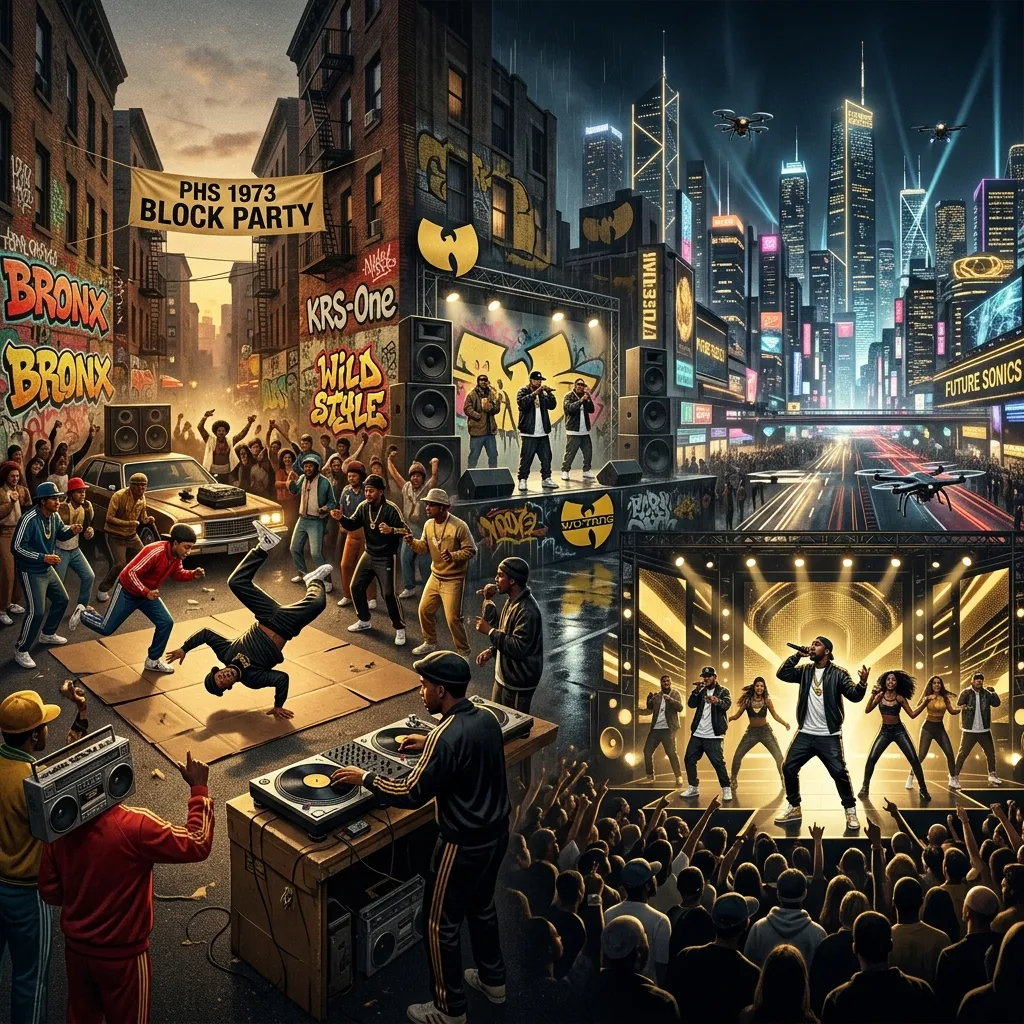
Before hip-hop was a billion-dollar, globally dominating industry, before it dictated high-fashion runways in Paris, and long before algorithms determined hit records, it was a localized movement born purely out of necessity.
In the early 1970s, the South Bronx was one of the most neglected communities in the United States. Plagued by systemic poverty, gang violence, and aggressive urban decay driven by the construction of the Cross Bronx Expressway, the youth of the borough were left with few resources. But from that socio-economic struggle, something revolutionary emerged. People took whatever technology they could access—turntables, microphones, spray paint, and cardboard—and created a cultural force that would eventually conquer the world.
Today, in 2026, hip-hop is not just a genre; it is the definitive global monoculture. This guide traces its unparalleled evolution from underground block parties to the boardrooms of global tech conglomerates.
The Four Pillars of Hip-Hop
Hip-hop was never just about the music. From its absolute inception, the culture was built on four foundational pillars, each representing a different form of creative expression for marginalized youth.
- MCing (Rapping): The art of rhythmic vocal delivery and rhyming over beats. It evolved from simple party-rocking and crowd hype to complex, multi-syllabic lyrical storytelling.
- DJing (Turntablism): The manipulation of records to create new music. Early DJs provided the essential sonic foundation by isolating and extending drum breaks.
- Breaking (B-boying): The athletic, highly competitive dance form that gave early hip-hop its visual and physical identity on the streets.
- Graffiti Art: The visual language of the streets. Graffiti writers turned subway cars and brick walls into moving, massive canvases, ensuring their names were seen across the city.
Together, these pillars formed a complete, self-sustaining cultural ecosystem. They gave young people a voice, an identity, and a profound sense of purpose in environments designed to keep them marginalized.
The 1970s: The Genesis and the Merry-Go-Round
On August 11, 1973, Clive Campbell—better known as DJ Kool Herc—threw a back-to-school party in the recreation room of 1520 Sedgwick Avenue in the Bronx. This night is widely recognized as the official birth of hip-hop.
Herc utilized a technique he called "the merry-go-round." Using two turntables and a mixer, he would isolate the instrumental "break" sections of funk and soul records (like James Brown's "Give It Up or Turnit a Loose")—the exact moments where the dancers went the hardest. By switching back and forth between two copies of the same record, Herc could extend a 15-second drum break into a 5-minute continuous loop.
This looping technique laid the literal foundation for modern hip-hop production. Soon after, figures like Grandmaster Flash perfected the technical aspects of DJing (inventing the crossfader technique and the quick-mix theory), while Afrika Bambaataa organized the Universal Zulu Nation, helping to channel gang energy into positive cultural expression.
The 1980s: The Drum Machine and The Golden Era Begins
While the 1970s relied on live DJs spinning physical vinyl, the 1980s introduced the technology that would allow hip-hop to be recorded and sold commercially: the drum machine. The Roland TR-808, with its booming, synthetic kick drum, changed the sonic landscape entirely, fueling hits like Afrika Bambaataa's "Planet Rock" (1982).
By the late 1980s, the "Golden Era" of hip-hop had arrived. This period (roughly 1986–1996) is widely regarded as a time of unprecedented creativity, diversity, and artistic ambition.
The Rise of Conscious Rap
Artists like Public Enemy, KRS-One, and A Tribe Called Quest used hip-hop as a direct vehicle for social commentary, political activism, and Afrocentric philosophy. Public Enemy's It Takes a Nation of Millions to Hold Us Back (1988) wasn't just an album; it was a sonic manifesto that proved hip-hop could be both commercially successful and intellectually challenging.Boom Bap is a style of hip-hop production popularized in New York in the late 80s and 90s, characterized by hard-hitting, acoustic drum samples (the "boom" kick and "bap" snare) and heavy jazz or soul samples.
The Coastal Divide
Simultaneously, the emergence of N.W.A from Compton, California, marked a seismic geographic and thematic shift. Straight Outta Compton (1988) introduced aggressive, reality-based "gangsta rap" to mainstream America, sparking national debates about censorship and police brutality.This geographic expansion eventually fueled the infamous and tragic East Coast-West Coast rivalry, pitting The Notorious B.I.G. and Bad Boy Records against Tupac Shakur and Death Row Records.
The 2000s: The Ringtone Era and the Blog Era
As hip-hop entered the new millennium, it underwent a fundamental commercial transformation. The gritty realism of the 90s gradually gave way to the flashy, highly commercial "Bling Era," dominated by Cash Money Records, Bad Boy, and Roc-A-Fella.
By the mid-2000s, the industry was disrupted by the introduction of the digital ringtone. The "Ringtone Rap" era was characterized by highly repetitive, extremely catchy, hook-driven songs designed specifically to be sold as 30-second digital downloads on cell phones. Artists like Soulja Boy cracked the code of early digital marketing, using YouTube and Limewire to bypass major labels entirely.
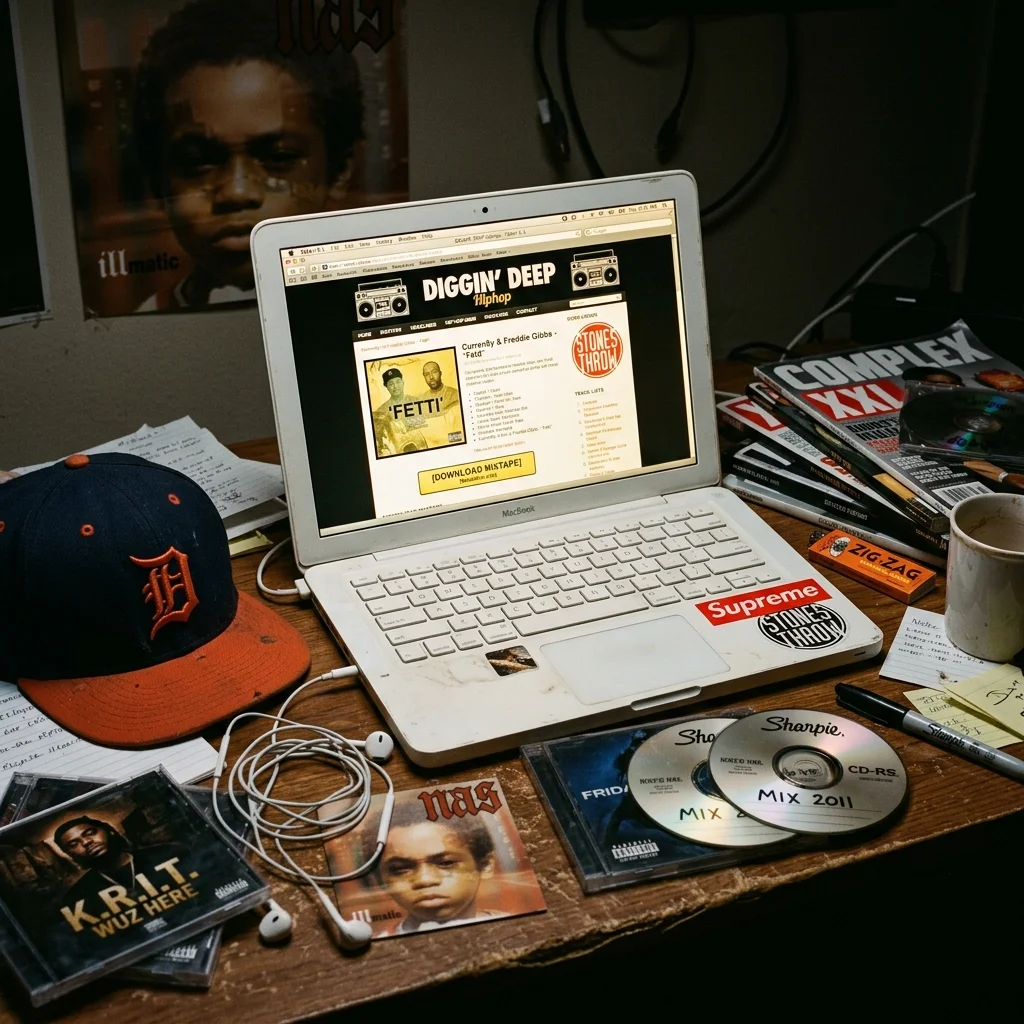
This transition paved the way for the "Blog Era" (late 2000s to early 2010s). Independent music blogs became the ultimate gatekeepers, championing a new wave of alternative, highly lyrical artists like J. Cole, Kendrick Lamar, Drake, and Kid Cudi, who built massive online followings by releasing free mixtapes directly to fans.
The 2010s: Trap Dominance and the Streaming Revolution
If the 2000s were defined by the digital download, the 2010s were defined by the streaming revolution. Spotify and Apple Music transformed the global music economy, and hip-hop was uniquely positioned to dominate this new format.
Trap is a subgenre of Southern hip-hop characterized by fast, complex hi-hat patterns, heavy 808 bass, and dark, synthesized melodies, originally originating in Atlanta in the early 2000s.
The 2010s saw Atlanta solidify its position as the undisputed capital of global hip-hop. Producers like Metro Boomin and artists like Future, Migos, and Young Thug pushed Trap music from a regional sound into global pop dominance.
During this same period, Chicago gave birth to Drill music.
Drill is a dark, aggressive subgenre of hip-hop originating in Chicago, defined by its grim lyrical content reflecting street violence, sparse 808-heavy production, and off-kilter hi-hats.
Chief Keef's explosive arrival in 2012 laid the blueprint for Drill, which subsequently migrated to the UK and eventually to Brooklyn, Brooklyn Drill, shaping the sound of the late 2010s and early 2020s.
The 2020s to 2026: The Tech-Driven Monoculture
In 2026, hip-hop is no longer just music; it is a sprawling, global economic force heavily intertwined with venture capital, artificial intelligence, and high fashion.
The Technological Evolution of Production
To understand how hip-hop evolved, one must look at the tools used to create it.| Era | Defining Technology | Key Capability | Sonic Impact |
| :--- | :--- | :--- | :--- |
| 1970s | Direct Drive Turntables | Looping breakbeats manually | Raw, live party energy |
| 1980s/90s | Akai MPC60 & SP-1200 | Digital sampling & sequencing | Gritty, chopped Boom-Bap |
| 2000s | FruityLoops (FL Studio) | Piano-roll beat programming | Fast hi-hats, synthesized Trap |
| 2020s | Cloud-based Splice | Instant global sample sharing | Globalized, genre-blending sounds |
| 2026 | AI Stem Separation & Gen-AI | Instant vocal cloning & extraction | Rapid prototyping, hyper-pop trap |
Today, hip-hop artists are no longer just seeking record deals; they are launching hardware companies (like Bose Records), signing massive sports partnerships, and investing deeply in Silicon Valley startups. Hip-hop has survived commercialization, government censorship attempts, devastating internal conflicts, and massive technological disruption. It continues to evolve, absorb new global influences—from Afrobeats to K-pop—and push cultural boundaries.
What started in a single recreation room in the Bronx is now the universal language of the modern world.
---
Frequently Asked Questions
What was the first hip-hop song ever recorded?
While DJ Kool Herc invented the culture in 1973, the first commercially successful hip-hop record was "Rapper's Delight" by The Sugarhill Gang, released in 1979. It introduced rapping to a global audience and proved that hip-hop could be a viable, profitable recording genre.What are the four pillars of hip-hop?
The four foundational elements of original hip-hop culture are MCing (rapping), DJing (turntablism), Breaking (breakdancing), and Graffiti Art. Knowledge (understanding the history and social context of the culture) is often cited as the unofficial fifth pillar.How did streaming change hip-hop in the 2010s?
Streaming platforms removed the financial barrier to entry for fans, allowing younger, digital-native audiences to consume massive amounts of music instantly. Hip-hop's high-output mixtape culture was perfectly suited for streaming algorithms, allowing the genre to officially overtake Rock as the most popular genre in the US by 2017.What is the current era of hip-hop called?
While historians are still defining it, the current period (2020s-2026) is often referred to as the "Post-Monoculture" or "TikTok Era." It is characterized by hyper-fragmented micro-genres (like Rage, Phonk, and Detroit Scam Rap), where viral social media algorithms dictate chart success faster than traditional radio.---
Related Reading & Context
To dive deeper into the business side of the culture, read our analysis on Hip-Hop Business Empires in 2026 or explore how modern production techniques are shifting the landscape in AI vs. MPC: The State of Beat Making.