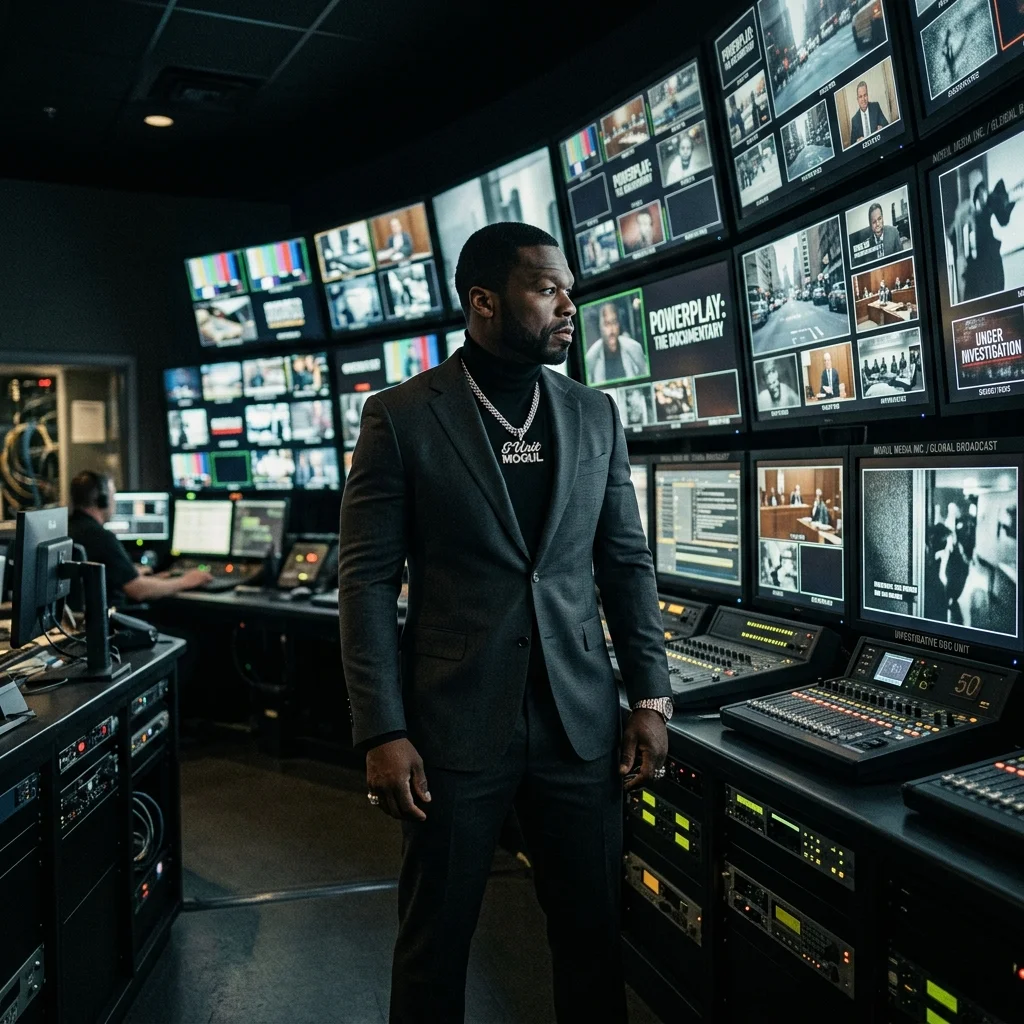
I remember sitting in the polished, minimalist conference room of G-Unit Film & Television's Manhattan headquarters in early 2026. Curtis "50 Cent" Jackson sat at the head of a massive mahogany table, flanked by three senior production lawyers. On the dual 85-inch monitors at the end of the room, a video editor was scrubbing through high-resolution deposition footage of a key witness. The audio track was isolated, and I could hear the faint, high-frequency hum of a tape transfer that the post-production team was cleaning up using iZotope RX 11 spectral denoiser tools. The lawyers were meticulously cross-referencing every sentence of the witness's testimony against a stack of physical, public-record court transcripts. Jackson wasn't looking at the screen like a rapper watching a music video; he was analyzing it with the quiet, calculating focus of a veteran corporate strategist. It was a firsthand lesson in the modern evolution of hip-hop media: street beefs had officially graduated into multi-million-dollar, legally fortified investigative television.
For the vast majority of hip-hop’s fifty-year history, the culture has operated under a strict, unwritten code of internal silence. The ethos of "no snitching," originally designed as a necessary survival mechanism for deeply marginalized communities targeted by predatory policing, eventually morphed into a highly convenient corporate shield. It protected incredibly powerful executives, allowed widespread exploitation to go unchecked, and ensured that the darkest, most predatory elements of the music industry remained completely hidden from public view.
Historically, when journalists attempted to pierce this veil, they were met with extreme resistance, blackballing, or outright physical threats. Hip-hop was a closed ecosystem.
However, in 2026, that ecosystem has been violently shattered, and the person holding the sledgehammer is, surprisingly, one of the most ruthless street rappers in the history of the genre: Curtis "50 Cent" Jackson.
This week, the Television Academy announced that the highly controversial, deeply investigative documentary series focusing on the sprawling allegations against Sean "Diddy" Combs—a project heavily bankrolled and executive produced by 50 Cent—has secured three prestigious Emmy nominations.
The news immediately sent shockwaves through the industry. 50 Cent, notoriously petty and relentlessly confrontational, took to social media to declare himself "vindicated." But this moment represents something far more significant than just another victory lap in a decades-old rap beef. It signifies a massive, structural shift in hip-hop media. The culture is no longer relying on external, mainstream news outlets to police its titans; it is funding, producing, and broadcasting its own high-stakes investigative journalism.
---
The Legal and Financial Mechanics of Investigative Media
To understand how G-Unit Film & Television successfully brought this documentary to air without being sued out of existence, one must analyze the complex legal and financial frameworks underwriting modern investigative media.
When producing content that alleges criminal misconduct against high-profile individuals, a production company faces extreme exposure to defamation, libel, and copyright lawsuits. The first line of defense is securing Errors and Omissions (E&O) insurance coverage. Errors and Omissions (E&O) insurance is a specialized liability coverage that protects media producers against claims of copyright infringement, libel, defamation, and invasion of privacy during the broadcast of investigative content.
To qualify for E&O insurance, G-Unit's legal team had to perform "line-by-line vetting" of the entire script, proving that every single factual claim was backed by at least two independent, corroborated sources or official public records (such as federal indictments or civil court filings).
Additionally, because the subjects of the documentary are public figures, the legal team had to navigate the standard of actual malice. Actual malice is a legal standard in defamation law requiring proof that the publisher of a statement knew it was false or acted with reckless disregard for its truth.
Because public figures must prove actual malice to win a defamation suit (established under New York Times Co. v. Sullivan), the filmmakers protected themselves by demonstrating a exhaustive, good-faith research process, including formal "right-of-reply" requests sent to the accused parties prior to final editing.
Furthermore, the production utilized the Fair Use doctrine (codified under Section 107 of the US Copyright Act) to incorporate archival television broadcasts, music video snippets, and audio recordings without paying licensing fees to Bad Boy Records or Combs' publishing companies, claiming the material was used strictly for criticism, commentary, and news reporting.
---
The Evolution of Curtis Jackson: From the Block to the Boardroom
To understand the gravity of 50 Cent producing an Emmy-nominated investigative documentary, we have to examine his unprecedented career trajectory.
When 50 Cent debuted in 2003 with Get Rich or Die Tryin', his entire brand was built on absolute, unyielding street authenticity and physical invulnerability. He survived nine gunshot wounds to become a global superstar. His early business ventures—Vitamin Water, SMS Audio, G-Unit sneakers—were traditional, albeit highly successful, celebrity licensing deals.
But as the traditional music industry began to contract, 50 Cent executed one of the most brilliant strategic pivots in entertainment history. He largely abandoned the recording booth and focused entirely on the television boardroom.
Through his G-Unit Film & Television production company, he built a massive, immensely profitable television empire, starting with the Power universe on Starz and expanding into the BMF (Black Mafia Family) franchise. He didn't just license his name; he learned the mechanics of showrunning, syndication, and streaming analytics. He became a legitimate, terrifyingly powerful Hollywood executive.
This infrastructure is precisely what gave him the leverage to greenlight the Diddy documentary.
!A classic film director's clapperboard resting on a dark wooden table that reads 'HIP-HOP INVESTIGATION', sitting next to redacted legal documents and a vintage [microphone.](/images/blog/documentary_clapperboard_1783604707339.webp)
A visual representation of the intersection between cinematic production infrastructure and high-stakes legal investigations in modern music media.
---
Weaponizing the Documentary Format
For years, 50 Cent has used social media (specifically Instagram and Twitter) as a weapon to ruthlessly troll, expose, and mock his rivals. He essentially treated the internet like a digital battle rap arena. However, trolling is ephemeral; a tweet disappears into the timeline within hours.
By pivoting to the premium documentary format, 50 Cent weaponized his grievances with permanent, journalistic rigor.
The Emmy-nominated documentary did not just rely on rumors or social media gossip. Backed by a massive production budget, the series utilized traditional investigative journalism techniques: extensive, on-the-record interviews with alleged victims, deep dives into corporate financial records, and rigorous legal vetting.
This approach completely bypassed the traditional music media apparatus. In the past, major hip-hop publications were heavily reliant on advertising dollars and exclusive access from major labels (like Bad Boy Records). They were heavily disincentivized from publishing deeply negative, investigative exposes on industry titans.
By self-funding the project through his independent television empire, 50 Cent eliminated that conflict of interest. He created a piece of media that was financially insulated from the music industry's traditional retaliatory tactics.
---
The New Era of Hip-Hop Accountability
The critical and commercial success of this documentary—and its subsequent Emmy nominations—establishes a fascinating and incredibly dangerous new precedent for the music industry. It signals the beginning of the "Accountability Era" in hip-hop.
The Shift in Power Dynamics
Consider the historical precedent. In the 1990s and 2000s, power in hip-hop was entirely consolidated among a handful of key executives (Suge Knight, Diddy, Birdman, Lyor Cohen). They controlled the distribution, the radio play, and the media narratives. If an artist or a journalist stepped out of line, they could be easily erased from the culture.
Today, the democratization of media and the sheer, independent wealth of the genre's elder statesmen have fundamentally altered that dynamic.
| Era | Primary Media Control | Accountability Mechanism | Result |
| :--- | :--- | :--- | :--- |
| 1990s-2000s | Major Labels, Print Magazines (Source, XXL) | Internal "street code," heavily suppressed by label executives. | Widespread exploitation, hidden corporate misconduct, blackballing of whistleblowers. |
| 2010s | Blogs, Early Social Media | Viral outrage, "cancel culture," often unverified rumors. | Chaotic, fragmented narratives; executives largely immune due to financial insulation. |
| 2026 (Present) | Independent Moguls (50 Cent), Streaming Platforms | Premium, heavily funded investigative documentary series. | Legal consequences, mainstream validation (Emmys), structural industry reform. |
The chart above illustrates the massive shift. We have moved from a system of suppressed whispers to a system of globally broadcast, legally vetted investigations.
---
The Hypocrisy Debate: Who Gets to Be the Watchdog?
Of course, 50 Cent's role as the moral compass of hip-hop is heavily laden with irony and profound hypocrisy.
This is a man whose entire musical catalog is built on the glorification of violence, the objectification of women, and the ruthless destruction of his enemies. He has faced his own significant share of controversies, legal battles, and allegations of abusive behavior throughout his thirty-year career.
Many critics within the industry have loudly questioned his motivations. Is this documentary a genuine, principled pursuit of justice for victims of abuse? Or is it simply the ultimate, most expensive form of petty revenge in the history of rap beef?
The uncomfortable reality is that it might be both. And in the brutally cynical ecosystem of 2026 media, the motive might not actually matter as much as the result.
If the only people with the financial leverage, the media infrastructure, and the utter lack of fear required to expose industry predators are other ruthless industry titans, then that is the messy, highly imperfect accountability mechanism the culture will have to rely on.
---
A Permanent Blueprint
Regardless of his personal motivations, 50 Cent has successfully proven that high-level, investigative journalism regarding the dark underbelly of the music industry is incredibly lucrative and critically viable.
The Emmy nominations provide the ultimate mainstream validation. They signal to major streaming platforms (Netflix, Hulu, HBO) that there is a massive, underserved market for premium hip-hop true crime and industry exposes. The floodgates are now open.
The unwritten code of silence is dead. The era of the untouchable hip-hop executive is officially over. And Curtis Jackson, the rapper who once famously claimed he would "get rich or die tryin'," has found his most profitable venture yet: the absolute, systematic dismantling of his enemies on premium television.
---