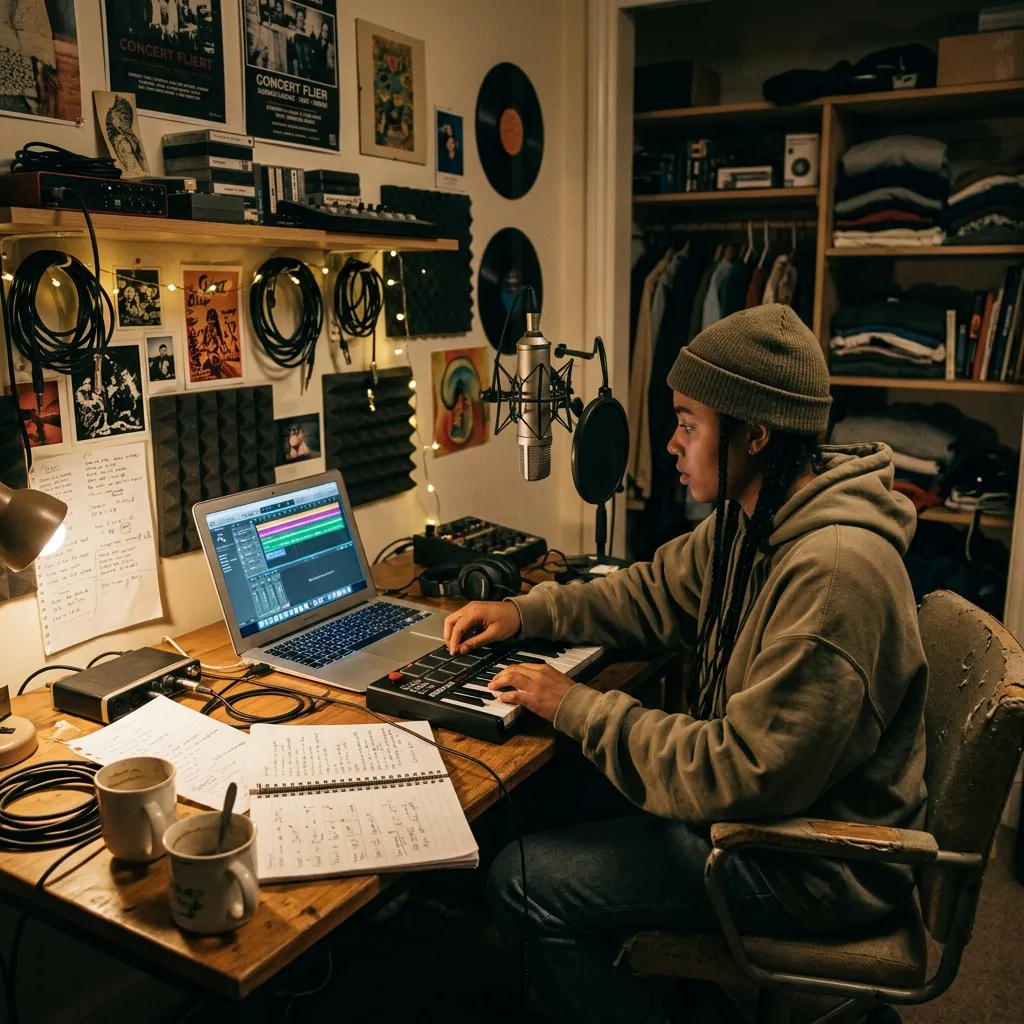
The Death of the "Discovery" Myth
When I was managing a showcase stage at SXSW earlier this year, I had a sobering conversation with an incredibly talented 19-year-old rapper from Houston. He had just finished a phenomenal set, but he was furious. "There weren't any A&Rs in the crowd," he complained. "How am I supposed to get discovered if the labels aren't watching?"
I had to explain to him the harsh reality of the 2026 music industry: No one is coming to "discover" you. The era of the record label talent scout wandering into a dark club and offering a million-dollar contract to an unknown artist is dead.
In 2026, major record labels are essentially massive banking institutions and marketing firms. They do not build artists from scratch; they acquire artists who have already built a profitable business. If you want to succeed in hip-hop today, you must stop treating your career like a lottery ticket and start treating it like a tech startup.
This comprehensive guide will break down the exact strategies, distribution models, and direct-to-fan marketing techniques required to build a sustainable, six-figure independent rap career without ever signing away your master recordings.
---
Why Independence is the Only Logical Starting Point
Historically, an artist needed a record label because distribution was physical. If you wanted your CDs in Best Buy or Tower Records, you needed a label's supply chain. Today, distribution is entirely digital and completely democratized. For $20 a year, you can have your music on the exact same Spotify shelf as Drake or Kendrick Lamar.
The Financial Reality: Signed vs. Independent
To understand why building an independent foundation is critical, you must understand the mathematics of modern music monetization:
| Revenue Stream | Major Label Artist (15% Royalty Rate) | Independent Artist (100% Royalty Rate) |
| :--- | :--- | :--- |
| 1 Million Spotify Streams | ~$600 (After recoupment) | ~$4,000 |
| $30 T-Shirt Sale | ~$4.50 (Often tied to 360 deals) | ~$22.00 (After production costs) |
| Sync Licensing (TV/Film) | Label owns the master, takes 50-80% | Artist owns the master, takes 100% |
| Creative Control | Dictated by A&R and quarterly trends | 100% autonomous |
| Data Ownership | Label owns fan email/demographic data | Artist owns and retargets data |
The math is undeniable. An independent artist with a dedicated fanbase of 10,000 people can generate significantly more liquid income than a major label artist with a casual fanbase of 1,000,000 people.
---
Step 1: The Modern Distribution Strategy
Uploading a 15-track album to Spotify and hoping the algorithm picks it up is financial suicide. In 2026, the strategy revolves around frequency and algorithmic momentum.
The "Waterfall" Release Method
The most successful independent artists in 2026 utilize the waterfall release strategy. The waterfall release strategy is a music distribution method where singles are released sequentially as expanding multi-track EPs to compound algorithmic streaming momentum.
Instead of dropping an entire album at once, you release a single every four to six weeks. When Single #2 drops, it is released as a two-track EP containing Single #1. When Single #3 drops, it contains Single #2 and Single #1.
This method ensures that every time a fan clicks on your newest release, the algorithm automatically queues up your older tracks, exponentially compounding your total stream counts and keeping you constantly active in algorithmic features like Release Radar.
Choosing the Right Distribution Partner
Not all distributors are created equal. You must choose your partner based on your current career stage:
The Aggregators (DistroKid, TuneCore): Best for artists in the early stages who are releasing a massive volume of music. An aggregator is a digital music distribution platform that acts as an intermediary to deliver audio files and metadata from independent creators to global streaming services.* You pay a flat annual fee, keep 100% of your royalties, and the interface is incredibly streamlined.
* The Services Models (UnitedMasters, Symphonic, AWAL): Best for artists who already have traction. These platforms often take a small percentage of your royalties (10-15%) but provide actual human support, playlist pitching, sync licensing opportunities (placing your music in video games or commercials), and brand partnerships.
---
Step 2: Stop Renting Your Audience (Direct-to-Fan)
The most dangerous mistake an independent artist can make in 2026 is building their entire fanbase on a platform they do not own, like TikTok or Instagram. If the TikTok algorithm changes tomorrow, or your account gets banned, your career is instantly erased.
Build an Owned Infrastructure
You must transition your fans from "rented" algorithmic platforms to "owned" platforms. The two most powerful tools for an independent rapper are Email Lists and SMS (Text Message) Communities. When you drop a new music video, an Instagram post might only be shown to 5% of your followers due to the algorithm. However, an SMS blast goes directly to the pocket of 100% of your most dedicated fans, with an open rate often exceeding 90%.The Value Exchange
Fans will not just give you their phone number for no reason. You must offer a "value exchange." For example: "Text this number to get the unreleased B-side of my new single, access to exclusive merch drops 24 hours early, and the password to secret pop-up shows." By offering tangible value, you build a database of "superfans" that you can monetize directly for the rest of your career.---
Step 3: The 2026 Marketing Playbook
You cannot market mediocre music. Your mixing, mastering, and vocal delivery must be competitive with mainstream artists. Assuming the music is industry-standard, here is the exact sequence for marketing an independent release in 2026.
1. The TikTok / Short-Form Hook Testing
Do not spend $5,000 on a music video for a song that hasn't been tested. Before the song is even officially released on DSPs (Digital Service Providers), create 15-second visual snippets focusing purely on the most catchy, memorable part of the song (the hook or a unique beat switch). Post these consistently across TikTok, Instagram Reels, and YouTube Shorts. If a snippet goes viral, you now have mathematical proof that the song is a hit before you spend a dime on promotion.2. The Conversion Funnel
A viral TikTok video is useless if those viewers don't become listeners. You must have a frictionless conversion funnel. Use platforms like Linktree or ToneDen in your bio. When a user clicks the link, they should be taken to a clean landing page where they can immediately click "Spotify," "Apple Music," or "Pre-Save." Do not make fans search for your name; the internet attention span is too short.3. Algorithmic Amplification
Once the song is released, funnel all of your initial traffic to Spotify within the first 48 hours. If the Spotify algorithm sees a massive influx of external traffic (from your SMS list and your TikTok bio), combined with high "Save" rates, it will flag the track as "highly engaging" and automatically inject it into Discover Weekly and Radio playlists, doing the heavy lifting for you.4. Strategic Paid Advertising
Only use paid advertising (Meta Ads, YouTube Ads) to pour gasoline on a fire that is already burning. If a song is completely dead organically, throwing $500 of Facebook ads at it will not save it. However, if a song is performing well organically in a specific region (e.g., Chicago), you can run highly targeted Instagram ads specifically aimed at fans of similar artists located in Chicago to amplify that localized momentum.---
Common Pitfalls for Independent Artists
The road to independence is littered with artists who made fatal business errors. Avoid these common traps to ensure your survival.
Mistake 1: Spending the Entire Budget on Production
An artist will save up $10,000, spend $9,000 on studio time and a cinematic music video, and leave $1,000 for marketing. The Fix: The music industry rule of thumb is a 50/50 split. If it costs $2,000 to record and mix an EP, you must have $2,000 saved specifically for the marketing, promotion, and visual assets required to push it. A brilliant song with zero marketing budget is just a file sitting on a hard drive.Mistake 2: Waiting for Perfection
Many artists hold onto music for years, endlessly tweaking the mix, waiting for the "perfect moment" to drop their debut masterpiece. The Fix: Perfection is the enemy of progress. In the streaming era, volume and consistency are vastly more important than perfection. Drop the music, learn from the analytics, improve your craft, and drop the next track. The market will tell you what is perfect.Mistake 3: Faking the Metrics
We discussed this in our streaming deep dive, but it bears repeating: Do not buy fake streams, fake followers, or fake Instagram comments. The Fix: Industry professionals, venue promoters, and algorithms can spot fake numbers instantly. Having 100,000 Instagram followers but only getting 12 likes on a post destroys your credibility. It is significantly better to have 500 genuine, highly engaged fans than 50,000 fake bots.---
Frequently Asked Questions (FAQ)
What is a "Superfan" and why are they important?
A superfan is a listener who will purchase a physical vinyl record, buy a $50 hoodie, and pay for a concert ticket. Industry data suggests that it only takes 1,000 true superfans (spending roughly $100 a year on your art) to generate a sustainable $100,000 annual career. You do not need millions of passive streamers; you need a concentrated core of superfans.Should I still upload my music to SoundCloud in 2026?
Yes, but strategically. While Spotify and Apple Music are for your official, polished releases, SoundCloud remains the ultimate platform for raw, unmastered leaks, DJ mixes, and tracks containing uncleared samples that would get you sued on major platforms. It is a fantastic tool for community building and rewarding hardcore fans with exclusive "throwaway" tracks.Do I need a manager to be independent?
In the early stages, no. You must be your own manager, booking agent, and marketing director. You should only hire a manager when your career is generating so much administrative work (booking shows, negotiating brand deals, handling merchandise logistics) that you literally no longer have time to record music. 15% of zero dollars is zero.What is "Sync Licensing" and how do I get it?
Sync licensing is when your music is "synchronized" to visual media (movies, TV shows, video games, commercials). It is one of the most lucrative income streams for independent artists. To get sync placements, you must own 100% of your masters and publishing, ensure your music is mixed to broadcast standards, and submit your catalog to reputable sync agencies or music libraries.Can an independent artist get on the Billboard charts?
Yes. Thanks to the integration of streaming data into chart calculations, several independent artists have debuted on the Billboard charts. However, this requires a massive, coordinated effort from a highly engaged fanbase buying digital downloads and generating millions of streams within a strict 7-day tracking window.---
The Power is in Your Hands
The music industry has never been more competitive, but it has also never been more accessible. You no longer need permission from an executive in a corner office to release your art to the world. By treating your rap career as a legitimate small business, focusing on direct-to-fan infrastructure, and executing the waterfall release strategy, you can build a lucrative empire from your bedroom.
If you are going to compete with the majors, your audio quality must be flawless. Ensure your home studio is equipped with the right gear by reading our definitive guide to Beat-Making in 2026: The Best DAWs, Plugins & Hardware, learning how to navigate the complex world of modern 360 deals, and understanding the structure of major record labels in the digital era.